Businesses by State
Find the right fit for your property
Filter by service and location, then select up to three providers to compare contact details, recorded coverage and source-check status.
Our listing criteria & source-check process · Source checks cover the named facts, not workmanship or licensing.
Compare providers
Select providers below to start a comparison.
1 business · HI - Nuuanu Pali
Honolulu, HI
SERVPRO of Central Honolulu, Kapolei
Cleaning Services · Fire Damage Restoration · Mold Remediation · Storm Damage Restoration · Water Damage Restoration
808-746-5641View business →Not yet source-checked
View comparison ↑STORM DAMAGE & PROPERTY RECOVERY
Hawaii: storm damage risks and recovery
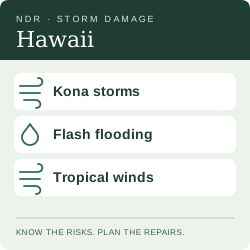
Hawaii's storm damage risks reflect steep terrain, island coastlines and large rainfall differences over short distances. NOAA describes Kona storms bringing heavy rainfall, flash flooding, landslides and high surf, while tropical systems can bring additional wind and water damage. A property's island, elevation and exposure matter more than a general statewide weather description. A wet windward location and a comparatively dry leeward neighborhood can require very different drainage and repair discussions after the same system passes.
Local challenges after a storm
Where runoff or deposited debris affects a building, establish whether the first assessment needs site, drainage or structural expertise. Interior cleanup cannot determine whether a slope or supporting ground is stable. Follow local access restrictions and document the surrounding area from a safe location. Ask contractors to distinguish water entering through a roof or window from water reaching the building across the ground, because those paths can lead to different repair scopes.
Island logistics deserve attention before a restoration agreement is signed. Confirm whether the crew and required equipment are available on your island, what materials may need shipping and how the building will remain protected during delays. Ask who monitors temporary roof or opening protection if additional rain arrives. For coastal properties, identify any known seawater exposure and ask which systems require specialist assessment. Do not assume that a provider's general island coverage establishes immediate access to your address.
Choosing restoration help in Hawaii
Compare Hawaii storm damage restoration businesses through written descriptions of extraction, cleaning, drying and rebuilding. Request itemized freight, equipment and monitoring charges where applicable, together with the procedure for approving additional work. Ask what evidence will support decisions to retain materials or close wall assemblies. Coordinate reconstruction requirements with the appropriate county building authority and keep photographs, findings and approvals in a single project file. A useful provider explains its limits and handoff arrangements as clearly as its services, especially when the job requires several trades or materials that are not locally stocked.
For a multi-island business, ask which island-based crew and equipment would perform the work rather than relying only on the company's overall coverage. Review all repair exclusions before authorizing additional work.
Climate and hazard source: NOAA/NCEI State Climate Summary for Hawaii. The recovery questions are NDR editorial guidance, not a property assessment or a live weather warning. Follow current instructions from local authorities.