Businesses by State
Find the right fit for your property
Filter by service and location, then select up to three providers to compare contact details, recorded coverage and source-check status.
Our listing criteria & source-check process · Source checks cover the named facts, not workmanship or licensing.
Compare providers
Select providers below to start a comparison.
1 business · IN - Indian Village
Lafayette, IN
SERVPRO of Lafayette
Cleaning Services · Fire Damage Restoration · Mold Remediation · Storm Damage Restoration · Water Damage Restoration
(765) 420-0077View business →Not yet source-checked
View comparison ↑STORM DAMAGE & PROPERTY RECOVERY
Indiana: storm damage risks and recovery
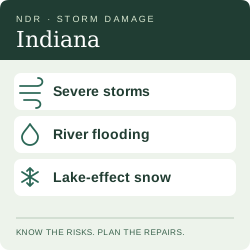
Indiana's storm damage risks include warm-season thunderstorms, flooding, tornadoes and winter snow or ice. NOAA also identifies heavy lake-effect snow near Lake Michigan, with impacts sometimes reaching farther inland. Northern snowbelt communities therefore face different conditions from properties along central and southern rivers. An effective restoration discussion connects the particular storm to roof openings, water entry and access conditions, rather than treating the entire state as one uniform recovery environment.
Local challenges after a storm
Where heavy rainfall falls on already wet ground, inspect the property's drainage context as well as its interior. Ask whether water arrived through the building envelope, a lower-level opening or another route requiring a specialist. Record visible waterlines and affected materials when access is safe. A basement cleanup quote should make clear whether it addresses only the immediate water damage or also includes investigation and correction of the underlying entry point.
In northern Indiana, winter damage may involve roof leakage during changing temperatures, heavy snow or ice-related tree impacts. Ask roofing and restoration contractors how they coordinate temporary protection and permanent repairs if another storm arrives. Where structural movement or impact damage is suspected, determine who evaluates the building before routine replacement work proceeds. Access to wet insulation and enclosed spaces should be discussed explicitly; dry-looking room surfaces do not describe every affected component.
Choosing restoration help in Indiana
When selecting Indiana storm damage restoration, compare written scopes covering extraction, cleaning, drying verification and repair handoff. Confirm service to your community and ask which trades the business performs itself. Request equipment rates, monitoring charges and a process for approving additional work. For attached or commercial buildings, include shared access and utility arrangements in the discussion. Contact the appropriate local building authority about permanent repairs, and retain photographs, estimates and inspection findings. The best comparison makes responsibility clear at each stage, including who documents that affected materials are ready for rebuilding and who resolves any excluded drainage or electrical concerns.
For a Lake Michigan snowbelt property, ask how winter roof findings will be linked to the interior areas being dried or proposed for replacement. Keep copies of findings and approved changes available to every relevant contractor.
Climate and hazard source: NOAA/NCEI State Climate Summary for Indiana. The recovery questions are NDR editorial guidance, not a property assessment or a live weather warning. Follow current instructions from local authorities.