Businesses by State
Find the right fit for your property
Filter by service and location, then select up to three providers to compare contact details, recorded coverage and source-check status.
Our listing criteria & source-check process · Source checks cover the named facts, not workmanship or licensing.
Compare providers
Select providers below to start a comparison.
2 businesses · NH - Franklin
Manchester, NH
Restoration Management
(888) 743-0245View business →Not yet source-checked
View comparison ↑Laconia, NH
SERVPRO of The Lakes Region
Cleaning Services · Fire Damage Restoration · Mold Remediation · Storm Damage Restoration · Water Damage Restoration
(603) 527-2518View business →Not yet source-checked
View comparison ↑STORM DAMAGE & PROPERTY RECOVERY
New Hampshire: storm damage risks and recovery
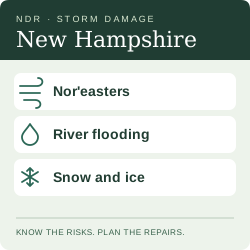
New Hampshire storm damage spans a short but exposed coastline, inland river valleys and mountainous communities. NOAA describes winter storms, extreme precipitation, flooding and the effects of tropical systems and nor'easters. A coastal building exposed to water and wind may need a different assessment from a house affected by runoff or heavy snow inland. The most useful starting point is the property's actual setting and damage pathway, rather than a single statewide storm label.
Local challenges after a storm
For seacoast properties, ask contractors to distinguish flood or wave effects from rain entering through damaged exterior components. Document accessible waterlines and roof or window openings without entering unsafe areas. Where erosion or movement is visible, determine who will evaluate the supporting ground and structure. Contact the local authority about reconstruction requirements before assuming that replacing wet finishes is the only work necessary or that a cleanup agreement includes those evaluations.
Inland and mountain locations require careful coordination around snow, ice, tree impacts and road access. Ask who monitors temporary roof protection while permanent repairs are pending. If a building is seasonal or the owner cannot attend, agree on access arrangements and how findings will be photographed and communicated. The restoration plan should address enclosed spaces and insulation where affected, with a clear explanation of what measurements support later rebuilding rather than relying on dry-looking surfaces.
Choosing restoration help in New Hampshire
Compare New Hampshire storm damage restoration providers through an itemized scope for emergency protection, extraction, cleaning, drying and reconstruction. Confirm coverage for the address and current availability under the actual travel conditions. Review equipment, monitoring and travel charges and identify excluded trades such as electrical or structural work. Establish written approval procedures for changes discovered during the job. Keep photographs, findings and invoices together, and check permit requirements with the responsible building authority. The directory's recorded business facts help organize a comparison, but they do not replace confirmation of capabilities, qualifications and responsibility for each stage of recovery.
For a mountain property, discuss temporary weather protection and monitoring access before agreeing on a schedule that depends on deliveries or exterior work. Keep photographs and written repair approvals together for reference.
Climate and hazard source: NOAA/NCEI State Climate Summary for New Hampshire. The recovery questions are NDR editorial guidance, not a property assessment or a live weather warning. Follow current instructions from local authorities.