Businesses by State
Find the right fit for your property
Filter by service and location, then select up to three providers to compare contact details, recorded coverage and source-check status.
Our listing criteria & source-check process · Source checks cover the named facts, not workmanship or licensing.
Compare providers
Select providers below to start a comparison.
1 business · SC - Ravenel
Ravenel, SC
SERVPRO of South & West Charleston
(843) 823-7400View business →Not yet source-checked
View comparison ↑STORM DAMAGE & PROPERTY RECOVERY
South Carolina: storm damage risks and recovery
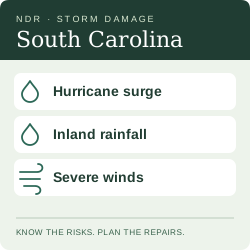
South Carolina storm damage can come from coastal surge, tropical rainfall, severe thunderstorms and tornadoes. NOAA describes hurricane effects extending inland, along with heavy precipitation events that cause flooding beyond the shoreline. The recovery problem differs between low-lying coastal properties, urban drainage areas and inland buildings exposed to trees and strong winds. Before comparing contractors, establish how this particular property was affected and which components need investigation, temporary protection or permanent repair.
Local challenges after a storm
For coastal buildings, ask the inspection team to distinguish floodwater from rain entering through damaged roof or window openings. Record visible waterlines and any known seawater exposure when access is safe. A restoration estimate should explain which areas and utilities are included and when structural or electrical expertise is needed. Check with the responsible local authority before rebuilding affected floodplain components rather than assuming emergency cleanup settles all reconstruction requirements.
Inland, wind damage and tree impacts can leave a building exposed while further rainfall remains possible. Clarify who coordinates debris removal, temporary coverings and any structural evaluation. Ask how protection will be monitored if work is delayed. For flooding from runoff or nearby waterways, identify the entry route and any need for drainage investigation. A contractor should explain the relationship between those causes and the interior materials it proposes to clean, retain or remove.
Choosing restoration help in South Carolina
Compare South Carolina storm damage restoration businesses on a written scope and actual address coverage. Separate extraction, cleaning, drying verification and reconstruction, with itemized equipment and monitoring charges. Ask which trades are included and who handles permits, excluded work and communication with other crews. Retain photographs and inspection findings by room and date, particularly when successive weather systems create separate losses. Confirm crew availability directly and require written approval for additional work. A broad regional service-area claim or an emergency-response advertisement does not establish that a provider has assessed the property or committed to a particular arrival time.
For a coastal property, ask whether affected lower enclosures, access stairs and exterior service equipment are included in the proposed inspection and repair discussion. Keep copies of findings and approved changes available to every relevant contractor.
Climate and hazard source: NOAA/NCEI State Climate Summary for South Carolina. The recovery questions are NDR editorial guidance, not a property assessment or a live weather warning. Follow current instructions from local authorities.