Businesses by State
Find the right fit for your property
Filter by service and location, then select up to three providers to compare contact details, recorded coverage and source-check status.
Our listing criteria & source-check process · Source checks cover the named facts, not workmanship or licensing.
Compare providers
Select providers below to start a comparison.
1 business · TX - Porter Heights
Houston, TX
SERVPRO of The Woodlands/Conroe
Cleaning Services · Fire Damage Restoration · Mold Remediation · Storm Damage Restoration · Water Damage Restoration
(281) 419-9796View business →Not yet source-checked
View comparison ↑STORM DAMAGE & PROPERTY RECOVERY
Texas: storm damage risks and recovery
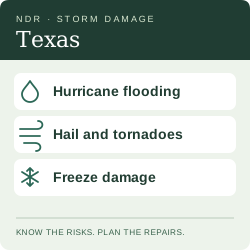
Texas storm damage varies enormously between the Gulf Coast, central river country, northern plains and western communities. NOAA describes hurricanes and extreme rainfall alongside tornadoes, damaging hail and winter weather. These hazards can produce very different losses: coastal water intrusion, rapid runoff, wind-opened roofs and damage associated with freezing conditions. A statewide service claim is therefore less useful than a clear explanation of the contractor's experience, access and proposed process for the particular building and event.
Local challenges after a storm
On the coast, distinguish flood or surge effects from rainfall entering through exterior openings. Inland, establish whether water crossed the ground, followed a drainage route or came from a damaged building system. Document visible waterlines and exterior findings only where access is safe. Ask the inspection team which structural, electrical or plumbing questions need another specialist before routine cleanup or replacement of finishes proceeds.
Hail and wind losses need documented observations of roof coverings, flashing, windows and other exposed components. Connect those findings to any interior moisture assessment rather than assuming all ceiling stains share one cause. During winter recovery, clarify whether plumbing repairs and building drying are separate scopes. Large or rural properties may involve detached structures and long delivery distances; identify each building and access constraint before agreeing to a single price or schedule.
Choosing restoration help in Texas
Compare Texas storm damage restoration providers using itemized plans for emergency protection, extraction, cleaning, drying verification and reconstruction. Confirm service to the actual county and current crew availability. Review equipment, monitoring and travel charges, and ask who coordinates permits or excluded trades. Request the measurements used before walls and floors are closed and require written approval for additional discoveries. Contact the responsible local building authority about permanent repairs. Keep findings, photographs and invoices organized by room and date, especially when more than one storm or source of water is involved. Directory information helps structure the comparison; it does not establish suitability for every type of Texas loss.
For a winter water loss, identify whether plumbing repairs, water extraction and reconstruction are separate agreements, with clear responsibility for the handoff between trades. Keep all written inspection and repair records.
Climate and hazard source: NOAA/NCEI State Climate Summary for Texas. The recovery questions are NDR editorial guidance, not a property assessment or a live weather warning. Follow current instructions from local authorities.