Water extraction is only the beginning of recovery after a commercial water loss. Moisture can remain in flooring, walls, and other building materials long after standing water is gone. Removing that moisture requires a coordinated drying process.
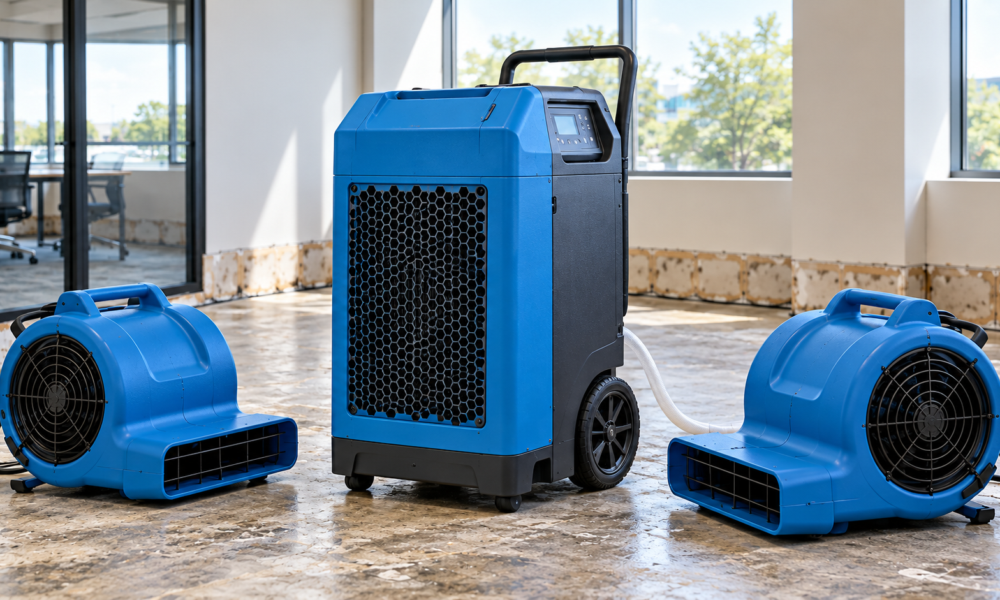
Air movers and commercial dehumidifiers perform different but complementary jobs. Air movers support evaporation from wet surfaces, while dehumidifiers remove the resulting moisture from the air. Monitoring helps confirm whether affected materials are drying as intended.
What Air Movers Do
Air movers circulate air across accessible wet surfaces, helping moisture evaporate from building materials. They also help distribute conditioned air throughout the drying area.
However, air movement alone does not remove water vapor from the building. If evaporation adds moisture to the air faster than it can be removed, humidity can accumulate and drying can slow.
What Commercial Dehumidifiers Do
A commercial dehumidifier removes moisture from the air, supporting continued drying of surrounding materials.
Refrigerant dehumidifiers draw air across cold coils, where water vapor condenses into liquid. That water is collected and drained or pumped away, and the equipment returns warmer, drier air to the space. Low-grain refrigerant, or LGR, units are designed to maintain useful performance as the air becomes drier.
Desiccant dehumidifiers use moisture-attracting material. They can be useful for projects requiring very dry air or operation across a wider temperature range. Their moisture-laden reactivation exhaust must be managed according to the equipment’s installation requirements.
Why the Equipment Works Better Together
The drying process follows a continuous cycle:
- Air movers help moisture evaporate from accessible wet surfaces.
- Dehumidifiers remove that evaporated moisture from the surrounding air.
- Air movers circulate the conditioned air across affected materials.
- Drying continues as moisture moves from within materials toward their surfaces.
This partnership helps maintain the vapor-pressure difference that drives drying. Conditions at the wet surface and in the surrounding air matter more than whether the room simply feels warm.
Consider an office affected by a plumbing leak. Air movers may produce strong evaporation, but inadequate dehumidification can allow humidity to build. Conversely, a powerful dehumidifier may create favorable room conditions while poorly circulated corners or enclosed assemblies remain wet.
Equipment selection depends on the affected materials, room layout, temperature, evaporation load, and actual machine performance. There is no universal air-mover-to-dehumidifier ratio for every commercial loss.
Why Lower Humidity Does Not Always Mean Dry Materials
Relative humidity changes with temperature. Heating air can lower its relative humidity even when no water vapor has been removed. A lower humidity percentage alone does not prove that building materials are drying successfully.
Restoration technicians may track temperature and humidity ratio alongside material moisture readings. Atmospheric measurements describe the drying environment; material readings show whether the structure is responding.
Heat can support evaporation, but excessive temperatures can damage sensitive finishes or move equipment outside its effective operating range.
Planning and Monitoring the Drying Process
Effective drying begins with stopping the water source, extracting recoverable liquid water, and evaluating which materials can be restored. Contamination, electrical hazards, and concealed moisture must be assessed before aggressive air movement begins.
Technicians then arrange equipment to reach affected surfaces, maintain appropriate clearances, and support circulation. Commercial projects also require attention to power availability, occupied areas, equipment noise, and access routes.
A floor that looks dry may still conceal moisture underneath. Technicians use material-appropriate measurements, compare results with established drying targets, and track progress at consistent locations. Equipment should be adjusted as conditions change and removed when documented drying goals are met.
For commercial property owners, successful structural drying depends on coordinated equipment and measurable progress. Air movers support evaporation, dehumidifiers manage airborne moisture, and monitoring confirms the results.
Explore National Disaster Recovery for more information about water damage, structural drying, and recovery resources.





Facebook
RSS