
Water Damage
How Air Movers and Dehumidifiers Work Together After Commercial Water Damage
How Air Movers and Dehumidifiers Work Together After Commercial Water Damage
Water extraction is merely the first stage in the recovery process from a commercial water loss. Moisture can remain within the floor, the walls and other building materials long after the standing water has been removed. That moisture has to be removed through a properly co-ordinated drying process.
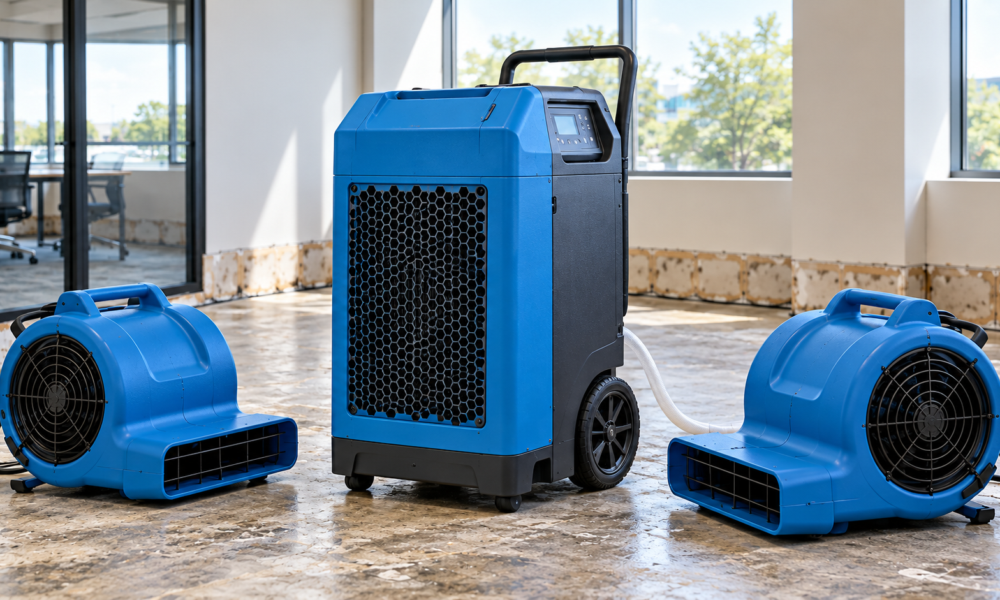
Air movers and commercial dehumidifiers do quite different things, but they work together. The air mover aids the evaporation from wet surfaces, the dehumidifier removes the moisture that’s then in the air. Monitoring is key to ensuring that the materials in question are indeed drying as required.
What Air Movers Do
Air movers circulate air over the accessible wet surfaces to assist in the evaporation of moisture from the building materials. They also assist in the distribution of the conditioned air throughout the drying area.
Air movement on its own won’t remove the water vapour from the building. If evaporation is adding moisture to the air at a faster rate than it can be removed then humidity will build up and drying will slow.
What Commercial Dehumidifiers Do
A commercial dehumidifier removes the moisture from the air and thus enables the continued drying of the surrounding materials.
Refrigerant dehumidifiers work by drawing air past cold coils where the moisture in the air condenses into liquid. The unit then collects and drains (or pumps) that liquid water and returns the now warmer, drier air to the space. Low grain refrigerant (LGR) units are designed to maintain their performance as the air gets drier.
Desiccant dehumidifiers use a moisture absorbing material. They can be of use in applications where very dry air is required or where operation over a wider temperature range is required. The reactivation exhaust from the moisture loaded desiccant must be dealt with in accordance with the equipment installation requirements.
Why the Equipment Works Better Together
The drying process follows a continuous cycle:
- Air movers assist with the evaporation of moisture from any accessible wet surfaces.
- Dehumidifiers remove the moisture which has been evaporated from the surrounding air.
- Air movers are used to circulate the conditioned air over the affected materials.
- Drying continues as moisture moves from within the material to the surface.
This partnership helps to maintain the vapour pressure difference which is what drives the drying. It’s the conditions at the wet surface and in the surrounding air that are important rather than how warm the room is.
Think of an office impacted by a plumbing leak. The air movers will certainly drive a lot of evaporation but if the dehumidification is insufficient then the humidity will build up. On the other hand a very effective dehumidifier can be quite good at creating good conditions in the room whilst still having some wet spots in the corners or in the enclosed assemblies.
Equipment selection is a function of the materials involved, the layout of the room, the temperature, the evaporation load and the actual performance of the machine. There is no one air mover to dehumidifier ratio that will work in every commercial loss situation.
Why Lower Humidity Does Not Always Mean Dry Materials
Relative humidity varies with temperature. Heating air will reduce its relative humidity even if no moisture has been taken out of it. A lower humidity percentage in itself doesn’t prove that the building materials are drying.
Restoration techs can monitor temperature and humidity ratio as well as material moisture readings. The atmospheric readings will tell you what the drying environment is like, the material readings will tell you whether the structure is actually responding.
Heat will promote evaporation but too much heat can damage sensitive finishes and can take the equipment outside its effective operating range.
Planning and Monitoring the Drying Process
Effective drying commences with cutting off the water source, removing the recoverable liquid water and establishing which materials are capable of being restored. Contamination, electrical hazards and hidden moisture need to be established prior to any aggressive air movement being introduced.
Technicians then get the equipment in position to get at the affected surfaces, maintaining the correct clearances and providing for adequate airflow. Commercial projects will also have to take into account power availability, occupied areas, equipment noise and access routes.
A floor that appears dry may still be damp underneath. The technician will take measurements appropriate to the material, compare them to established drying targets and monitor progress at the same locations. Equipment will be adjusted as the conditions change and removed when the required drying levels have been achieved.
For commercial property owners, effective structural drying is all about having the right equipment and being able to measure progress. The air movers assist with evaporation, the dehumidifiers deal with the moisture in the air and the monitoring is what gives you the confirmation that you’re getting results.
Check out National Disaster Recovery for more information about water damage, structural drying, and recovery resources.
Related Items




Facebook
RSS