Restoration & Service Businesses in Vermont
Find the right fit for your property
Filter by service and location, then select up to three providers to compare contact details, recorded coverage and source-check status.
Our listing criteria & source-check process · Source checks cover the named facts, not workmanship or licensing.
Compare providers
Select providers below to start a comparison.
Browse cities served in this state
6 businesses
South Burlington, VT
G.W. Savage Corporation
(802) 660-8900View business →Not yet source-checked
View comparison ↑Williston, Vermont
Paul Davis Restoration of Northern Vermont
802-864-5551View business →Not yet source-checked
View comparison ↑Hermitage, TN
ProTek Crane Solutions
(877) 938-6718View business →Not yet source-checked
View comparison ↑Business directory
PuroClean Water Damage Restoration Serving Arlington, Vermont
View business →Not yet source-checked
View comparison ↑Williston, Vermont
ServiceMaster Elite in Vermont
(802) 766-0020View business →Not yet source-checked
View comparison ↑Williston, VT
Water & Fire Damage Restoration in Williston
802-864-5551View business →Not yet source-checked
View comparison ↑STORM DAMAGE & PROPERTY RECOVERY
Vermont: storm damage risks and recovery
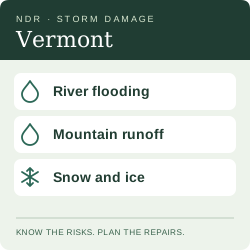
Vermont storm damage is closely tied to mountain watersheds, river valleys and winter weather. NOAA describes heavy rainfall, flash floods, river flooding following rain and snowmelt, and severe snow or icing events. Tropical remnants can also produce serious inland flooding. A property does not need to be near the coast to experience a major water loss. The first assessment should establish whether the problem is roof leakage, runoff, river water or a broader site and structural issue.
Local challenges after a storm
Where flooding affects a valley property, document visible waterlines and deposited material from safe locations. Ask which supporting-ground, drainage and structural questions require specialist evaluation before interior rebuilding proceeds. A cleanup company may handle wet finishes without determining that the surrounding site is ready for repair. If access routes or service connections are affected, describe those constraints before the contractor proposes an equipment plan or completion date.
Winter restoration requires clear coordination between exterior protection and interior work. Ask who monitors temporary coverings if additional snow, rain or freezing conditions interrupt permanent repairs. For older or seasonal buildings, clarify access to enclosed spaces and how findings will be communicated when the owner cannot attend. The estimate should explain how affected insulation, flooring and wall assemblies will be assessed and what measurements will support later decisions to retain, remove or close them.
Choosing restoration help in Vermont
Compare Vermont storm damage restoration providers through written scopes separating extraction, cleaning, drying verification and reconstruction. Confirm the service address, present road access and crew availability. Request equipment, monitoring and travel charges, plus a list of excluded structural, electrical or other specialist work. Contact the responsible local authority about permanent repair requirements and ask who coordinates the necessary approvals. Keep photographs and inspection findings organized by room and date, particularly when repeated flooding creates separate episodes of damage. Directory information helps start the conversation, but each company needs to explain its capabilities and responsibilities for the actual property and recovery conditions.
For a river-valley property, keep room photographs linked to exterior observations so restoration and site specialists work from a consistent account of the damage. Keep all written inspection and repair records.
Climate and hazard source: NOAA/NCEI State Climate Summary for Vermont. The recovery questions are NDR editorial guidance, not a property assessment or a live weather warning. Follow current instructions from local authorities.